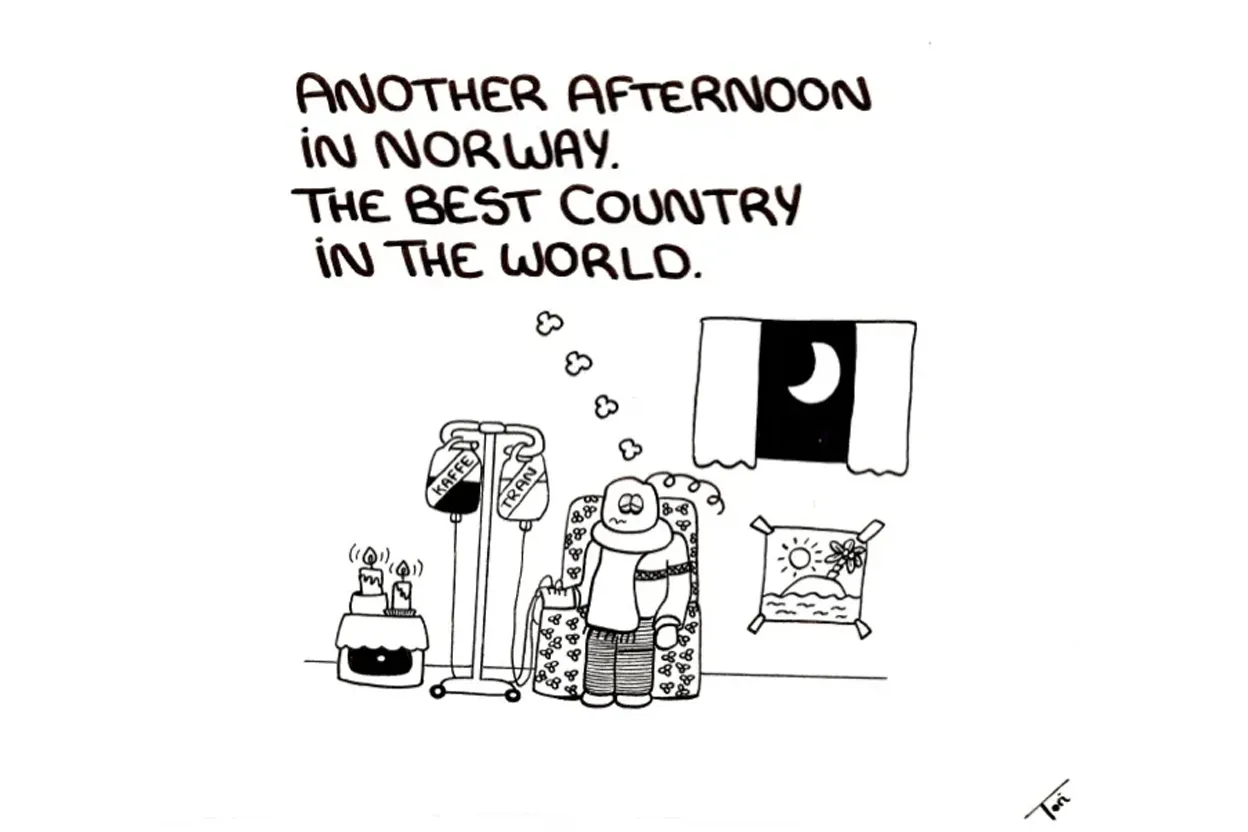
Credit image: Tori Lind Kjellstad
The internet is filled with breathtaking pictures of Norwegians fjords and lakes with pristine water, red wooden cabins and beautiful people hiking. “This is Norway” it usually says on those pictures and videos. Sure, those places exist and it is Norway, but Norway is also many other things. A new study by OsloMet (Oslo Metropolitan University) shows that 30,000 foreigners leave Norway every year (project EXITNORWAY). The researcher asks “Norway is lovely, why are people leaving?”. After almost 13 years in Norway, and as a foreigner myself, I can imagine a few reasons why people would leave. Norway is lovely indeed, but there are many reasons for foreigners to change their mind and leave after all.
1. Hard to make Norwegian friends
It is possible to make Norwegian friends, of course, but it is harder to make local friends in Norway than almost anywhere else in the world. A survey by InterNations showed that Norway is 55th on the list, making it to the bottom 10 of the countries in the world where it is easiest to make local friends. The main reason is that Norwegians have built their own social network since early childhood. They have friends from kindergarten, primary school, middle school and high school. Then they have made friends at folkehøyskole, university and during Russ. They’ve made friends in summer camps, in youth political parties they were members of. Then when they finish their studies, they’ll maybe make a few friends along the way from work, but basically their friend quota is filled and you are late for that friendship train. They don’t have time for you anymore, however cool you may be. The last train you might be able to catch is making friends from work and with parents of other kids the same age as your kids (if you have any). But that implies that you speak Norwegian, and that they are interested in making new friends. It is however possible, read this for more tips on how to make local friends.
2. The complexity of raising kids in Norway
About kids, raising children in Norway is a different ballgame than doing so in your home country. In Norway, the state has in a way a higher degree of protection duty on all kids living on the territory than their own parents. Any complaint or even a simple call to the Child Protection Services (Barnevernet) has to be followed up by a home visit and an investigation by the authorities. In Norway any kind of corporal punishment is totally illegal, whereas in other countries, for example the UK, smacking a child is still legal as long as it is “reasonable punishment”.
Barnevernet has been widely criticised in international media and accused of taking children away from their parents based on no proof, while others in Norway claim Barnevernet is not moving fast enough to protect children exposed to abuse in their own homes. In any case, even if you don’t do anything illegal as a parent in Norway, raising children in Norway is bound by a lot of written and unwritten rules which can be tricky for foreign parents to follow – and know about. From expectations at school, how to dress them for every season, and more.
Many foreigners are for example shocked at the food given to children in daycares (barnehage) but also the lack of cantine and warm food given to kids in school.
If you come from a country where education is important, you’ll be surprised by the Norwegian education system which does not give marks or grades to kids until they turn 13, and which let’s kids watch television during school hours while still letting them go home by 1.30pm.
School is not free either, and from the age of 1 until the age of roughly 12 you’ll need to pay roughly 3500 NOK per month per child (reduced price for the second and third child). This is because daycare is until 6, and even public daycares aren’t free. From 6 to 12 years old school is technically free but unless you are not a working parent, there is now way you can pick them up at 1pm when they are done, so you’ll need to pay after school activities until you finish your own job. Food given to kids is also a huge topic, with mostly unhealthy options such as bread several times per day with sweet and way too salty spreads.
3. The price of Eating And Going Out
The price of eating out is pretty outrageous even for people earning a decent salary. You might be able to do it if you don’t have kids, but otherwise count 250 NOK for a meal for one person, that is not counting the drinks, desserts or alcohol – which has insane prices compared to anywhere. Drinking a glass of wine out in a bar can cost around 80 NOK and there is no beer under 70 NOK either.
4. Arrogance of Norwegians regarding other cultures
In 2018, the US Pew Research Center did a survey among many people in the world on nationalism. People in 15 European countries were asked to what degree they agree with the statement “Our people are not perfect, but we have a superior culture than others” Norway is the only country where a majority of respondents completely or mostly agree that their culture is superior. 58 percent of Norwegians completely or mostly agreed to the statement. Spain was the one which answered they least agreed with that statement.
From the survey, it seems national pride is also very widespread in Norway. 92% of Norwegians say they are either “very” or “somewhat” proud of being Norwegian.
Now those are numbers from a survey which might not represent the whole Norwegian population. Or maybe it does. In my experience, Norwegians are less arrogant about their culture being superior than Danes (where I lived a bit over a year), but still quite high.
I have heard stories from people coming from Russia, Ecuador or Brasil who have been met with quite offensive comments from “helpful” Norwegians. “This is soap, you might not know what it is in your country”. A friend was in a Norwegian university to study for a PhD and a person from the university told her “This is a computer, you might have never seen one”. She came from Russia. Another friend, Afro-American from the US, is consistently met with disdain, until she says she is from the US. “Ooohh that is different”.
If you are from an African country, or Muslim, racism of a higher level may occur, spoken or unspoken. My observation is that depending on where you come from and the color of your skin, many Norwegians will assume things about you. Decades of media coverage about Africa being extremely poor and a favorite destination for Norwegian missionaries is not helping. Neither is the rising anti-Muslim voices from the far right including in political parties which have been governing in recent years.
5. The terrible weather
The weather is also not something you’d stay in Norway for. It rains a lot in this country, and with climate change it will rain even more. Even in the middle of the summer it can snow in Finnmark. The summer can be 25 degrees and sunny or rainy with 8 degrees. You never really know. The winters are long, especially in the north, and many cannot deal with the lack of sunlight during the darkest months of the year.
6. The high taxes
The tax system is based on a solidarity principle, which means the more you earn the more you pay. For some people that might not be ideal. Collected taxes are used for schools, roads and hospitals. I have met many people along the years you think it is outrageous to pay so much tax, whether one uses those services or not. But as a French, taxes in my country are even higher, and in Norway there is less corruption than in many other countries, so it works for me. In Norway you’ll pay around 35% taxes on your salary if you earn around 500-600.000 NOK.
7. The unhealthy food culture
Don’t get me wrong, there are wonderful fresh produces available in Norway, such as fish and carrots. The problem is that fast food culture is on the rise in Norway, and there is an unbelievable amount of processed food. From what I see, people find using time to cook meals a waste of time, or they just claim they don’t have time.
A recent study showed that between 60 and 80% of all food bought by Norwegians in supermarkets are ultra-processed foods. Some supermarkets like Kiwi try to give a 15% price cut on vegetables, but it does not seem to be doing the trick. According to the Norwegian Health Institute, there are now more people overweight and obese than people who aren’t. Diabetes is also on the rise. People eat a lot of sugar, like really a lot, and not just on Saturdays (Saturday candy culture). It is however very easy to eat healthy food, as vegetables and basic staple food are available everywhere.
8. Hard to find a job
In some fields it is super easy to find a job, like most IT jobs, where they won’t even ask you to speak Norwegian. But in most fields it is hard to find a job, especially without a local network, studies in a Norwegian university and without language skills. Partners following their Norwegian partner are especially at “risk” since their partner probably has no idea how hard it can be. As a foreigner applying to jobs you are basically in competition with Norwegians who know people, speak the language perfectly and understand the social codes of interviews etc. But of course it is possible, many of us have managed, it is just a lot of work and some luck.
9. Surviving the Norwegian administration
The Norwegian administration has some perks, it is almost entirely digitalised and quite efficient. Unless you are waiting for something highly necessary and are not born here. For example, a Bank ID as well as a personal number are things you cannot live without, yet it might be hard and long to get. Changing immigration status – unless from the EU/Nordics- is also a long and painful process. On the bright side, once you’re in the system, everything is easy.
Of course there are also great sides to Norway, read 8 reasons to live in Norway for more of those 🙂




Leave a Reply