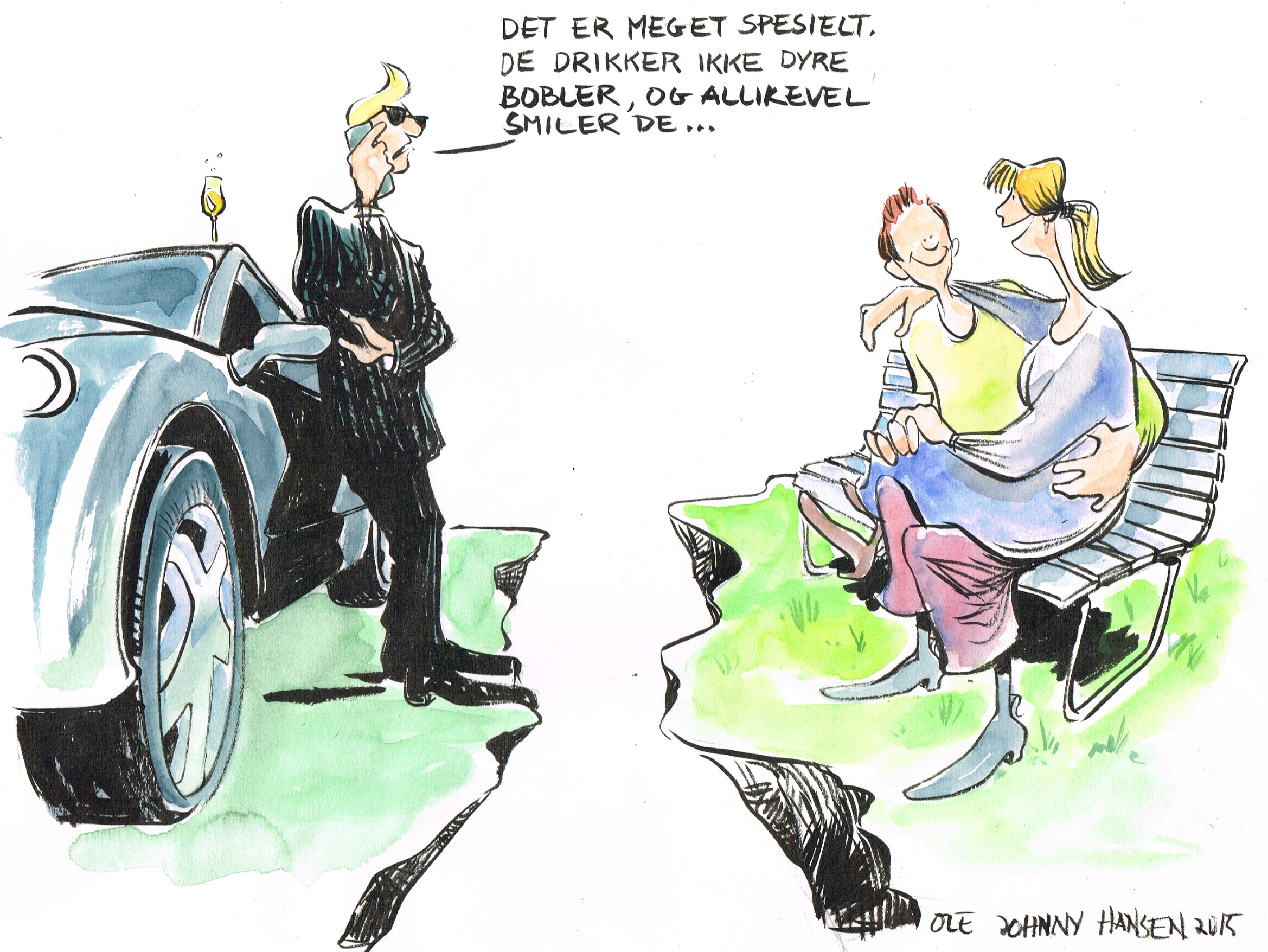

I am standing in the street, looking at it: at the people, the cars. I know something is different. But what? This is just another street in Oslo, like those I’ve been looking at for the past 5 years I’ve been living here. But I look closer, forgetting about my list of things to buy on my first day in my new flat in Bøler: washing liquid, milk and chocolate. What is in this street that is so different from what I have been seeing in my previous neighbourhood: Holmenkollen? Eureka! I know! It’s the people walking in the streets, coming from the supermarket. Never have I seen people in Holmenkollen carrying their plastic bags home. They all have cars they park in the parkings of supermarkets and then drive home to their big house.
And the cars in this street are so small compared to all the 4 Wheel drives I used to see everywhere in Vestkanten. And the streets, they are so narrow here. That is because 4 wheel drives take more space than Fiats I guess, so richer neighbourhoods need larger streets. And the people, they are different too. Here immigrants seem to actually live here with their families, not work for rich people. The only immigrants I met in Vestkanten were 1) Filipino maids walking the dogs and pushing prams, 2) workers from Eastern Europe (Polish, Lithuanians) working in houses and gardens and 3) immigrant looking kids who actually have been adopted by Vestkant couples, usually Asian looking. Rich Norwegians never adopt Black kids. And the last category 4) people like me renting a basement room or flat in those big houses.
When I moved to Norway 5 years ago I had no idea there were social classes differences in Oslo or even in Norway. Aren’t all Norwegians rich? All equally rich at least? After all the nation has millions buried in the sea, and there is no public debt, low unemployment, high wages, and Janteloven. Hum. I can tell you people are not equal in Norway. The very rich might not be rich for so many past generations like in France, and they might not flash their money like Southern Europeans do, probably because of Janteloven that makes them a bit shyer in their way to scream “I am rich” at the face of the world. But there are very very rich people here too, and their life is very different to the life of what people here call folkflest. Oslo, in particular, is divided in two by the Aker river (Vestkant = western area, Østkant = eastern area). Traditionally the working class was on the East and the rich on the West of the river. Now it seems like the past when one sees how expensive a flat in Grünnerløkka can cost, yet social differences remain. To read on this very topic: Want a Social Class Shock? Jump over the Aker river
At first nothing really shocked me in Vestkanten. Sure I found some people a bit arrogant, but what can it be compared to the elite in France? After a while I noticed that a single garage for a single house was bigger than my own flat. I started imagining where I would put my sofa in this 60m2 garage where three or four big cars were parked. One per adult living in each house, minimum. There was always minimum one 4 wheel drive, and usually a sporty one where the roof can open in the summer. Red, sometimes yellow. And a BMW, or a Mercedes. Then I imagined my kitchen, right there where they put their mess, and a bedroom where their 3rd or 4th car is parked. Then I usually looked at their houseso big and so beautiful, with terrasses and views on the fjord, gardens and so on. How ironic that my dream is to live in a flat as big as their garage.
According to a lady on the tbane who talked to me because she saw I was reading a French newspaper (Norwegian rich people love France), in Holmenkollen it is people with old money, whereas the nouveaux riches (she said that with disgust) live in Bygdøy. A house in Bygdøy would be fine for me!! Just like every single person I met in Holmenkollen, she made sure to remind me of her family or cultural link to my fabulous culture. “I loooove France. I speak a bit of French myself you know, but my daughter speaks perfect French”. Rich Norwegians always sent one or several of their kids, usually the girls, to study French one year somewhere in Paris or Provence.
She went on, telling me she spends half of the year in France or Spain. But she didn’t fail, in the end, to remind me why I came here: because the Norwegian economy is better than the French economy. “You are so lucky to be here”. “And when are you leaving? You know we can’t keep immigrants like you for longer than we need you”. Well, I don’t know. It’s okay for you to enjoy the sun in my country, why can’t I enjoy the equal pay and gender equality in yours? Rich people are not racist, mind you. They just point out facts of life.
The fact of life is that in Vestkanten people live in average 10 years longer than those living in Østkanten. They don’t look old in Vestkanten. I noticed after hearing many women whisper their fødselsnummer in pharmacies. Sure the plastic surgery helps too. Sometimes it was like looking at a freak show: the same nose, lips for women and always hair on men’s head. And they are so fit, and eat so well. Well, if others were doing your cleaning, cooking, gardening, taking care of your kids what would you have time for? For yourself: Looking at oneself in the mirror and going skiing to stay fit. One couple admitted to me they didn’t really need the money from the rent I was going to pay them. They would just feel so much better if there was someone there while they were away for their 5 week winter holiday in their summer house in the Carribean. Apparently not everyone in Norway goes on holidays to Syden.
Teenage boys in the bus in Østkanten don’t talk about their awesome week end on their dad’s yacht, neither do teenage girls hold a different designer bag everyday. Here the neighbourhood activities aren’t “Loppemarked for golf accessories” (fleamarket) but Bingo and strikkeklub (knitting club). People don’t read VG in Vestkanten, so vulgar. Not publicly at least. And children cannot possibly chose their own clothes: no stripy black and white tights, fairy wings and blue hats like I see everyday in the East. They look like miniature models of their parents, wearing Gant polo shirts and wearing their combed blond hair on the side. Until they become teenage rebels who get drunk and buy 1 million NOK worth of Russebuss.
I have now entered the supermarket, bought my chocolate and am thinking of becoming a member at the strikkeklub. I have walked up the street back to my new flat with a smile on my face, now I am home among my people. No more of that Vestkant crap.
An edited version of this article was published in VG under the title Den delte byen on the 13th of June, 2015.




Leave a Reply