Your cart is currently empty!

When people tell me “I loooovve French, it’s such a romantic language” it is obvious these people didn’t understand that our conversation was just about going down to the shop to buy a broccoli and oignons.
I believe there is no such thing as one language being the language of love. In Norwegian, like in every other language, you will find many words to express love, longing, desire and so have you. Here are a few language tips for those who want to understand the Norwegian language of love. This post was requested by Mathilde before Valentine’s day to have to words to say to her loved one!
Now as Norwegians have some difficulty and shyness in expressing such strong feeling as love, there are of course complicated subtleties here.
Three ways to express love
There are three ways to express likeness or love in Norwegian: Jeg liker deg, Jeg er glad i deg, Jeg elsker deg.
Apparently the first one is the weakest one (jeg liker deg/ham/hun) but also the one used the most. One uses it to talk about a not so strong feeling for not so close people. It can be a famous person you’ve actually never met before. A song, a band.
Jeg er glad i deg is something you can say to people who are close to you: your close friends, your partner (easier to say than Jeg elsker deg). The exact line between the use of Jeg liker deg and Jeg er glad i deg is still quite unclear to me. According to a friend of mine Jeg er glad i deg is used in the same way than I love you in English.
And this is where problems start. If you thought that Jeg elsker deg had the same meaning than I love you, you were fooling yourself. Jeg elsker deg in Norwegian is something one says very seldom and for extremely strong feelings which are not even close to being covered by a simple I love you. Especially in the way some English native speakers use it (a lot).
How do you know then that someone loves you? “Du burde vite det” (You should know) is the general answer. Great. Love in Norway is based on the assumption that others know you love them and they love you in return. I believe this is an easy excuse for people to keep strong feelings buried deep inside instead of trying to express them in any way. Why would I need to tell you I love you when I tapped you on the back, which should have been enough of a sign for you to be sure? (or a blink of an eye, or the quiver of a moustache, see Weird things Norwegians do).
Who should you say Jeg elsker deg to?
In England I remember being at Tesco’s and the 55 year old plumpy lady telling me “Hi love, what can I do for you?”. Hva i helvete? LOVE? I don’t even know you. Somehow Norwegians can use the word love in a different way than elske, but that is because you only elske those you are so close to your heart you could die for them: your wife, husband and your kids. Full stop. (sorry, the cashier from Rimi is not in that list).
But even those who really elske each other do not say it that often, that is also a little strange. Apparently a joke is going around in Norway that when a woman complains to her husband/samboer that he doesn’t say Jeg elsker deg enough to her, he answers “I said it to you once, and will let you know if that comes to change in the future”. How to kill the romance in half a sentence? Call a Norwegian.
Based on this only, it is hard to defend that Norwegian, or at least bokmål, is the language of love.
Other ways to say I love you
But then again, many words show there are some feelings going on here: kjærlighet (love, the noun), følelser (feelings), å ønske (desire), å være forelska (to be in love), kjærlighet ved første blikk (love at first sight), omhet (tenderness), kjæreste (boyfriend/girlfriend). Å være kjæreste in Norway is a much stronger relationship than a boyfriend or girlfriend in France for example. In Norway being kjæreste is very serious. That is why it can take ages before it actually happens, and then it can take 2 months only before you go from kjæreste to samboer status.
Another funny one: the use of kjære. You could think Kjære means Dear like you would say “Dear Anna” at the beginning of a letter and translate that by “Kjære Anna”. But actually kjære is also a word used for your dearest ones. Writing an email to your lawyer and starting with kjære in Norwegian is super strange.
How to love in nynorsk?
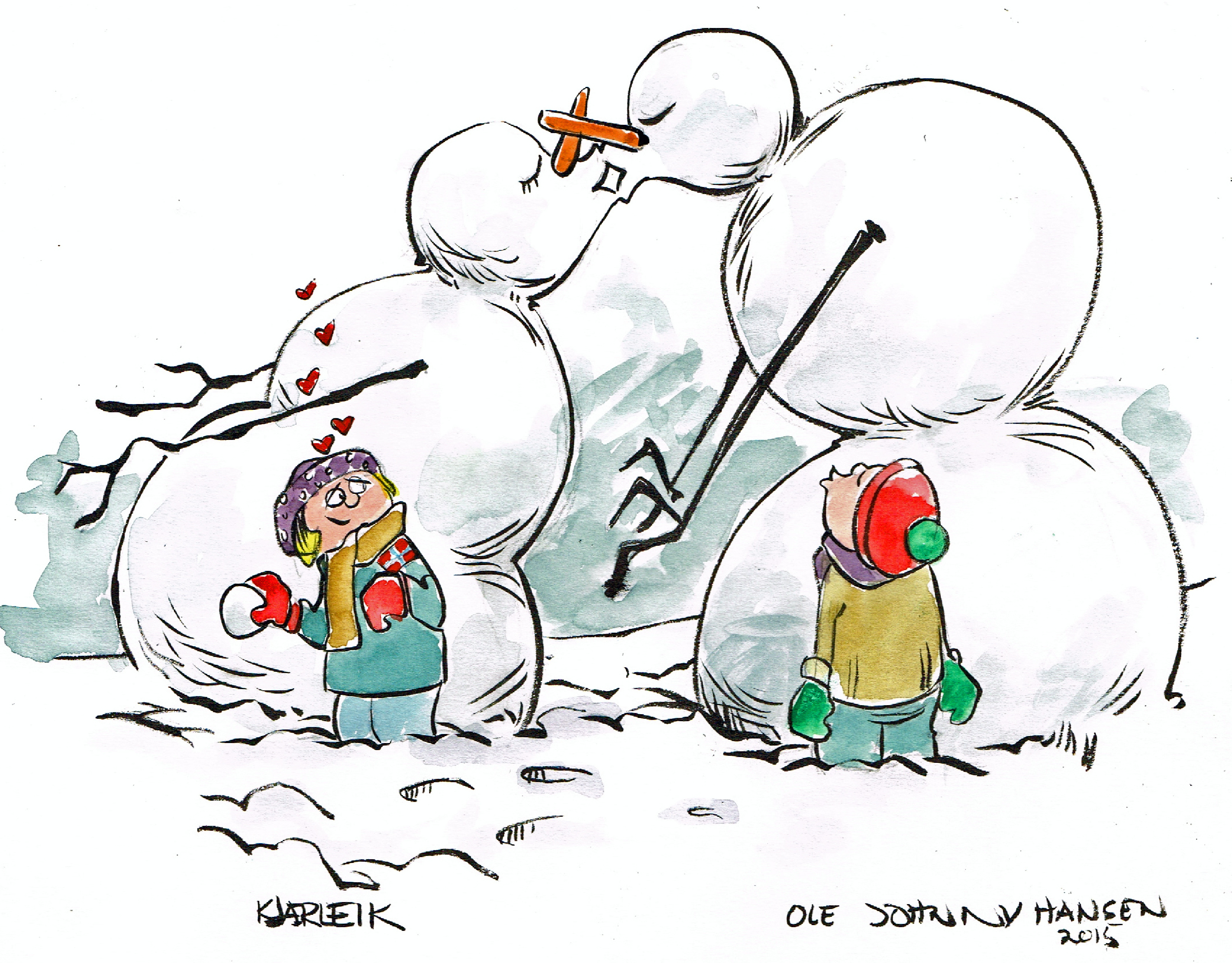
Then, in nynorsk, love is not kjærlighet but kjærleik (words love and play together). Nynorsk might be more the language of love than bokmål. Then again, all those men at sea for long months, God knows how much longing and desire there has been during centuries on the coasts of Norway.
A connected word is hugleik, which is translated to fantasy or mindgames, but often is understood to be a nynorsk word for love. Apparently there has been a lot of fun about the sentence “eg hugleikar deg av heile mi blodpumpe”, the same as “eg elskar deg av heile mitt hjarte” (I love you with all my heart – in nynorsk literally translated by something like: I fantasise you with all my bloodpump). This is one of the reasons, among others, that makes me think that nynorsk is much more a language of love than bokmål. Nynorsk always seems to have very colourful and illustrative ways of saying things, giving more space for creativity and wordplay. Then again, that’s just me, and I am far from being a nynorsk expert.
Little names Norwegians call each other
I was also wondering what Norwegians in love call each other, here is a sample: pus or kosepus (like the little cat), nuss (like the little kiss), elskling, hjertet mitt (my heart), lille venn (little friend), and my favorite: snuppa, although I don’t really remember what it means.
Kjerring seems to be the most controversial, some women thinking it’s nice, others thinking it is a horrible name to call a woman. Apparently it depends where you live and your dialect. Again, complicated.
In French, people call each other mon amour, mon coeur, mon bébé (but you have to have a blue and pink unicorn tattoo and a flashy car with written Harry all over it to call each other bébé), mamour. People very very seldom say “Je t’aime”. Maybe not as seldom as Norwegians, but not everyday either. French women usually complain their man never says it, and then when he is drunk says it every 5 minutes. “At least he said it to you!” would be her friend’s answer.
To conclude, Norwegian is not less or more the language of love than any other language. Okay maybe it is not the most romantic language in the world, but that really depends how much people actually use the words available to them. The real question is: are Norwegians romantic? For another blogpost.
P.S: I hope you love Ole Johnny Hansen’s illustration as much as I do (yes, I said love). And by the way, I have a new website, welcome! This article was published on VG.no under the title: Er norsk et kærlighetsspråk?




Leave a Reply